As a professional supplier of industrial fluid transfer solutions, HEBEI SINOPULSE TECH GROUP CO.,LTD. is dedicated to clarifying critical technical details that empower customers to make informed purchasing decisions. Our hydraulic hose, including the industry-standard din en 853 wire-braided series and durable hydraulic hose pipe, requires careful consideration of Inner Diameter (ID) and Outer Diameter (OD) – two key specifications that directly impact performance and compatibility. This article breaks down their definitions, differences, and why prioritizing ID standards is essential for optimal hydraulic system operation.
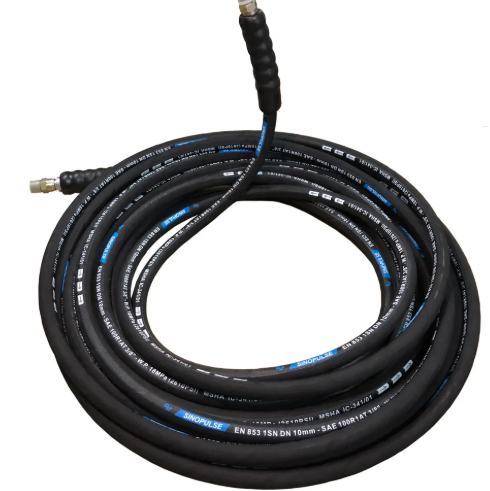
- HEBEI SINOPULSE TECH GROUP CO.,LTD. emphasizes that the inner diameter (ID) of a hydraulic hose serves as the foundational specification for hydraulic system efficiency, representing the hollow interior space through which oils, fuels, and other fluids travel. For our hydraulic hose products, this dimension is precision-engineered to meet strict flow rate requirements, ensuring fluid moves without excessive pressure drop or turbulence.
- A properly sized ID prevents flow restriction, which can lead to overheating, reduced actuator response, and premature wear of pumps and valves. Unlike external measurements, ID directly correlates to the system’s ability to deliver the required volume of fluid, making it indispensable for applications ranging from heavy machinery to industrial equipment. Our hydraulic hose lineup maintains consistent ID tolerances aligned with industrial standards, guaranteeing seamless compatibility with fittings and components while delivering reliable performance in critical operations.
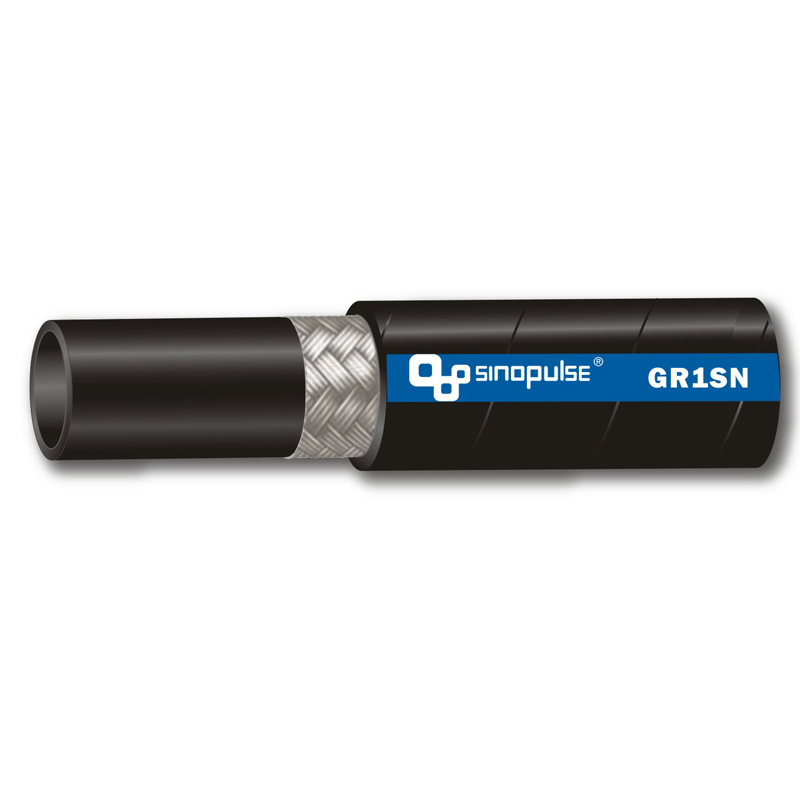
- The outer diameter (OD) of a hydraulic hose pipe encompasses the total width from one outer edge to the other, including the inner tube, reinforcement layers, and protective outer cover – a specification that plays a vital role in fitting compatibility and installation.
- HEBEI SINOPULSE TECH GROUP CO.,LTD. explains that while OD does not affect fluid flow, it must align with the dimensions of fittings, clamps, and installation spaces to ensure secure connections and proper integration.
- Our steel wire braided hydraulic hose pipe and steel wire spiral hydraulic hoses feature standardized OD measurements that enable tight seals with industry-standard fittings, minimizing leak risks and enhancing structural integrity. OD is particularly critical for applications with space constraints, such as compact machinery or confined industrial setups, where excessive width could hinder installation.
- However, our technical experts stress that OD should never overshadow ID in purchasing decisions, as even a perfectly sized outer diameter cannot compensate for an undersized ID that restricts fluid flow and compromises system performance.
- HEBEI SINOPULSE TECH GROUP CO.,LTD. highlights the fundamental functional differences between hydraulic hose ID and OD, emphasizing how each specification influences hydraulic system performance. ID acts as the fluid’s pathway, governing flow rate, pressure efficiency, and overall system responsiveness – a larger ID facilitates higher flow rates for high-power applications, while a properly matched ID prevents pressure loss.
- In contrast, OD focuses on physical compatibility, ensuring the hose fits with fittings, adapters, and installation spaces without compromising connection security. For example, our hydraulic hose features an ID engineered for optimal flow and an OD calibrated for universal fitting compatibility, creating a balanced design that prioritizes both performance and practicality.
- Another key distinction lies in their relationship to hose construction: ID is determined by the inner tube’s dimensions, while OD is shaped by reinforcement layers (such as wire braiding in DIN EN 853 products) and the outer cover. Understanding these differences helps customers avoid misalignment between components and ensures their hydraulic systems operate at peak efficiency.
-
How to Measure the Inner and Outer Diameter of a Hydraulic Hose?
-
-
The inner and outer diameters of hydraulic hoses are crucial for selection and installation. As a professional hydraulic hose manufacturer and supplier, we'll explain how to measure the inner and outer diameters of hoses.
Prepare the following tools before measurement:
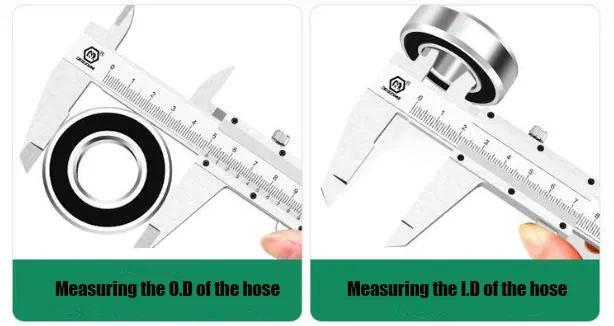
Vernier calipers (preferred tool): This is the most accurate and professional tool, capable of measuring both inner and outer diameters simultaneously.
Digital calipers: Provides more intuitive readings and high precision.
A roll of flexible measuring tape or ruler: Only suitable for rough estimation; not recommended for final measurement.
-
Measuring the hose inner diameter:
1. Clean the inside of the hose: Ensure the hose bore is free of grease, metal shavings, or other blockages. You can blow it out with compressed air.
2. Measure the inner diameter correctly: Insert the inner measuring jaws into the hose bore. Gently open the calipers until the tips of the jaws just touch the inner wall of the hose.
3. Read the value.
4. Take multiple measurements and average: Similarly, take multiple measurements at different cross-sections and angles of the hose (e.g., rotate 90 degrees and measure again), then average the results. This is because hoses may not be perfectly round.
-
- Measuring the hose outer diameter:
-
The method for measuring the outer diameter is largely the same as that for measuring the inner diameter, except for the placement of the calipers. When measuring the outer diameter of a hydraulic hose, the large outer diameter measuring jaws on the underside of the vernier caliper should be used. Place the hose between the two outer measuring jaws. Gently close the calipers until the measuring jaws are in even contact with the outer wall of the hose, but do not squeeze excessively. Similarly, take multiple measurements and average the results.
Hydraulic hose ID serves as the fluid’s flow path, directly influencing flow rate, pressure efficiency, and system responsiveness, while OD governs fitting compatibility and installation feasibility. HEBEI SINOPULSE TECH GROUP CO., LTD. explains that ID determines how well the system delivers required fluid volume, while OD ensures the hose connects securely and fits within available space – making ID the critical metric for performance and OD a practical consideration for integration.
DIN EN 853 standards establish strict tolerances for hydraulic hose ID to guarantee consistent flow performance across products, minimizing pressure drops and ensuring compatibility with system components. HEBEI SINOPULSE TECH GROUP CO.,LTD. adheres to these standards, calibrating ID to meet exact flow requirements while standardizing OD for universal fitting compatibility. The standard prioritizes ID as the core performance metric, ensuring that every compliant hose delivers reliable, predictable operation in industrial settings.
ID is more critical because it directly controls fluid flow – the primary function of a hydraulic hose pipe – while OD only affects physical compatibility. HEBEI SINOPULSE TECH GROUP CO.,LTD. notes that an undersized ID can cause pressure loss, overheating, and component damage, which directly impacts system functionality and longevity. In contrast, OD issues can often be resolved with compatible fittings, making ID the non-negotiable specification for optimal hydraulic system performance.
Yes, a hydraulic hose with the same OD can have different ID sizes, depending on the thickness of reinforcement layers (such as wire braiding in DIN EN 853 products) and the outer cover. HEBEI SINOPULSE TECH GROUP CO., LTD. explains that variations in construction materials and design can create differences in inner tube diameter even when the outer measurement is identical. This is why relying solely on OD to select a hose is unreliable – customers must verify ID to ensure it meets their flow rate and system requirements.
Our technical team provides personalized support by analyzing key application factors, including required flow rate, operating pressure, fluid viscosity, and system design constraints. HEBEI SINOPULSE TECH GROUP CO.,LTD. shares detailed hydraulic hose specifications aligned with DIN EN 853 standards, offers flow rate calculations, and recommends ID sizes tailored to specific use cases. We also provide customized solutions for unique applications, ensuring customers select a hose that optimizes system efficiency, reduces downtime, and extends equipment lifespan.
OUR LATEST NEWS
Strict quality control strict production team to ensure stable products quality. Scientific personnel management, efficient production arrangements to ensure our timely delivery.
02-242026
Comprehensive Guide to Safe and Effective Brake Hose Replacement Procedures
Maintaining your vehicle’s braking system is crucial for safety, and a key component of this system is the brake hose. Over time, brake hoses can deteriorate due to age, exposure to the elements, and constant pressure. This guide provides a comprehensive overview of brake hose replacement, covering everything from identifying when replacement is necessary to the process itself. Ignoring worn brake hoses can lead to brake failure, so understanding the signs and knowing how to address them is vital. Hydraulic Hose Plus offers a wide selection of high-quality brake hoses to ensure your vehicle’s safety. Brake hoses are responsible for carrying brake fluid under high pressure to the brake calipers at each wheel. As they age, the rubber can become brittle, crack, or swell. This compromises their structural integrity and can lead to leaks, reduced braking efficiency, or even complete brake failure. Regular inspection and timely replacement of brake hoses are essential safety measures. Signs of deterioration include visible cracks, blisters, bulges, or leaks, as well as a spongy brake pedal feel. Delaying brake hose replacement can significantly increase stopping distances and put you and others at risk.
02-112026
Comprehensive Guide to Silicone Auto Hoses for Enhanced Vehicle Performance
In the world of automotive performance and reliability, the often-overlooked component of the engine cooling and intake systems – the auto hose – plays a critical role. Traditional rubber hoses are prone to degradation from heat, oil, and pressure. This is where silicone auto hoses come into play, offering a superior alternative. This article delves into the benefits, applications, and considerations for choosing silicone hoses, providing a detailed overview for automotive enthusiasts, mechanics, and anyone looking to enhance their vehicle's performance. Ensuring your cooling and intake systems are equipped with quality hoses is crucial for preventing costly engine damage and maintaining optimal vehicle operation. Compared to traditional rubber hoses, silicone auto hoses offer a multitude of benefits. They exhibit exceptional resistance to high temperatures, often withstanding temperatures up to 500°F (260°C) without degradation. This is particularly important in modern engines that generate significant heat. Silicone also doesn’t swell or crack when exposed to oil, coolant, or other automotive fluids. This durability translates to a longer lifespan, reducing the frequency of replacements and saving you money in the long run.